Microorganism multiplication

This Riddler is about microorganisms multiplying. Will they thrive or will the species go extinct?

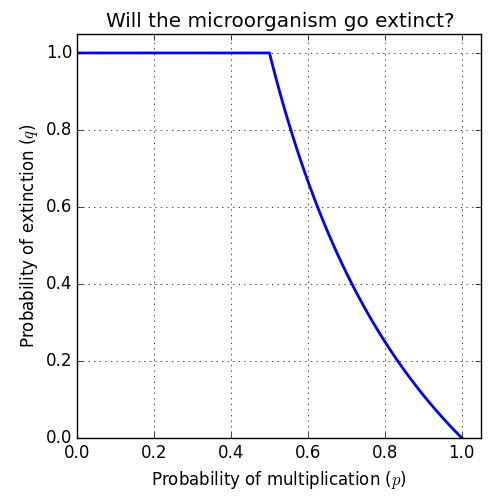
At the beginning of time, there is a single microorganism. Each day, every member of this species either splits into two copies of itself or dies. If the probability of multiplication is p, what are the chances that this species goes extinct?

Here is my solution:
[Show Solution]

Here is a more technical (and more correct!) solution adapted from a comment by Bojan.
[Show Solution]

Lucky spins in roulette

Roulette is a game where the dealer spins a numbered wheel containing a marble. Once the wheel settles, the marble lands on exactly one (winning) number. A standard American roulette wheel has 38 numbers on it. Players may place bets on a particular number, a color (red or black), or a particular quadrant of the wheel.

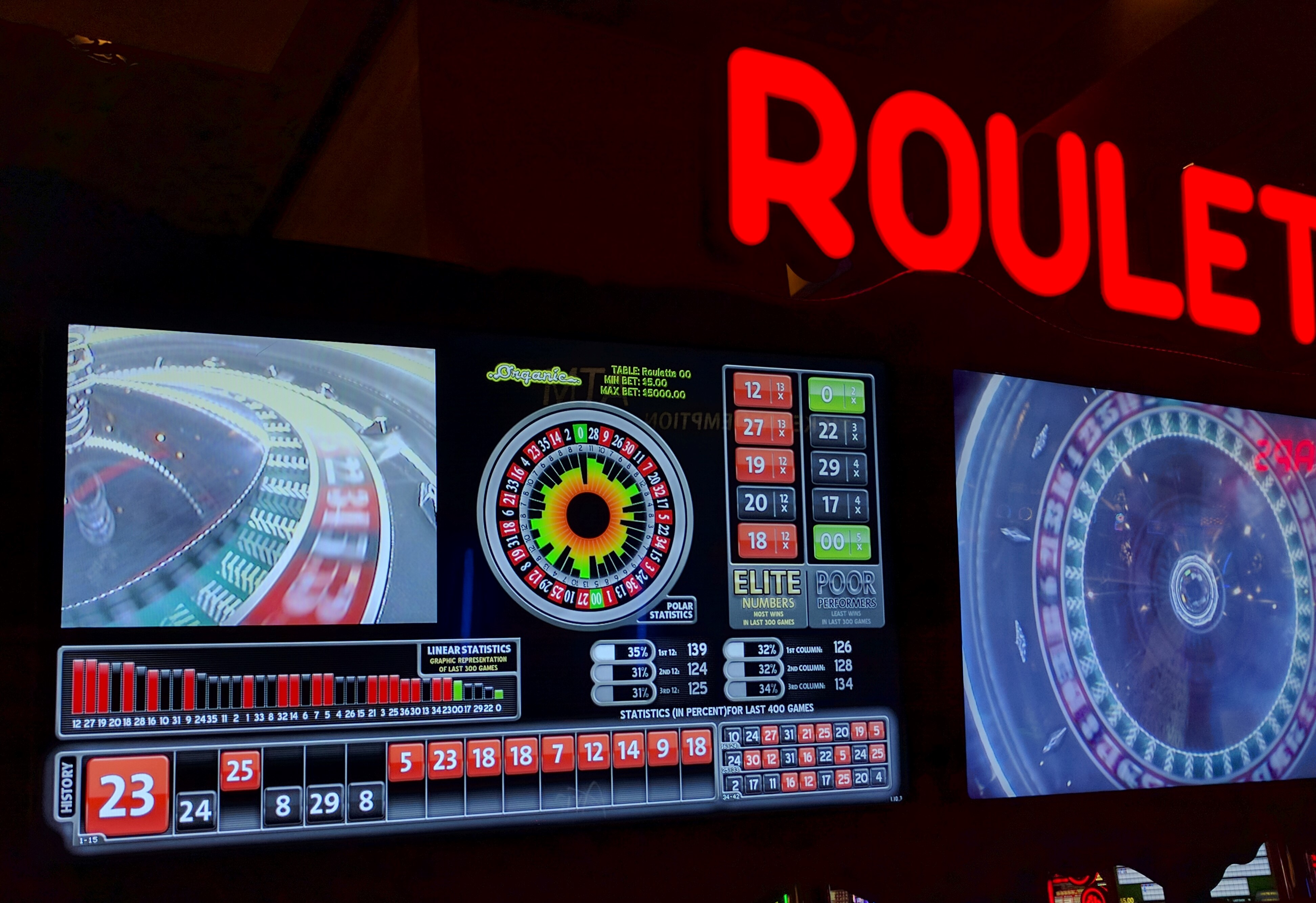
I was recently in Las Vegas for a conference, and I noticed that the roulette tables in the conference hotel were equipped with screens that display real-time statistics! A computer keeps track of the winning numbers for the past 300 spins and shows how frequently each number was a winner (see photo on the right). The two “elite numbers” were 12 and 27 (each occurred 13 times in the past 300 games) and the “poor performer” was 0, which only occurred 2 times.

Even if the roulette wheel is equally likely to land on each number, there will be natural fluctuations. Some numbers will obviously win more frequently than others in any finite number of spins. But what sorts of deviations can we expect? In the picture above, the spread between most frequent winner and least frequent winner was 13 to 2 over the course of 300 games. Is this normal? In other words, how big would the spread have to be before you suspected that the roulette wheel was rigged and was favoring some numbers over others? Let’s find out!

Results via simulation

Let’s suppose the wheel has $n$ different numbers on it, which we label $\{1,2,\dots,n\}$, and we spin it $m$ times when we aggregate our statistics. Note that in the actual roulette game, $n=38$ and $m=300$. If the game is fair, then each number is equally likely to occur and the spins are mutually independent. In other words, rolling a 4 on your first spin doesn’t make you more or less likely to roll a 4 or any other number on subsequent spins.

This sort of game is straightforward to simulate in Matlab. I wrote code that plays 300 games, counts how many times the most and least frequent numbers occur, and then repeats the entire process a large number of times. Then, I plotted a histogram showing what proportion of the time the most frequent number occurred 10 times, 11 times, etc. This is known as the empirical distribution. Here are the results of the simulation (aggregated over 100 million trials).

As we can see, a spread from 2 to 13 is right around what we expect! Of course, outliers are still possible. For example, it’s possible for the luckiest number to win 30 times out of 300 spins, but this only happened twice out of 100,000,000 simulated runs.

Analytical results

The roulette wheel lands on one of the $n$ numbers with equal probability. We then perform $m$ spins and count how many times each number occurs. If we place the counts in the vector $(x_1,\dots,x_n)$, where $x_1+\dots+x_n=m$, then this vector follows a multinomial distribution. The probability mass function is therefore:
\[
p(x_1,\dots,x_n) = {m \choose {x_1,\dots,x_m}} \frac{1}{n^m}
\]The bracketed term is called a multinomial coefficient and it counts the number of ways we can spin a “$1$” $x_1$ times, a “$2$” $x_2$ times, and so on. This also corresponds to the number of ways of depositing $m$ distinct objects into $n$ distinct bins, with $x_1$ objects in the first bin, $x_2$ objects in the second bin, and so on. It’s also equal to $\frac{m!}{x_1! \cdot x_2!\cdots x_n!}$. Meanwhile, $n^m$ is the number of different ways we can spin the roulette wheel $m$ times.

The probability that the most frequent spin occurs at most $k$ times is:
\[
F_\text{max}(k) = \sum_{\substack{ x_1+\dots+x_n=m\\x_i\,\le\,k}} p(x_1,\dots,x_n)
\]In other words, we must sum over all tuples $(x_1,\dots,x_n)$ of nonnegative integers that sum to $m$, that are each no greater than $k$. This is the cumulative distribution function, and in order to obtain the probability that the most frequent spin occurs exactly $k$ times (the probability mass function), we compute the difference:
\[
q_\text{max}(k) = F_\text{max}(k)-F_\text{max}(k-1)
\]A similar expression can be obtained for the probability that the least frequent spin occurs exactly $k$ times. These sums are impractical to compute because they have an astronomical number of terms. We must resort to approximation!

In our multinomial distribution, each $x_i$ has mean $\frac{m}{n}$ and variance $\frac{m}{n}\left(1-\frac{1}{n}\right)$. We will make the approximation that the $x_i$ are independent binomial random variables. Of course the $x_i$ are not truly independent since they must sum to $m$, but $n$ is large enough that this is a good approximation. We can therefore compute the distribution of the maximum by using the cumulative distribution:
\begin{align}
F_\text{max}(k) &= \mathbb{P}(x_1\le k,\dots,x_n\le k) \\
&\approx \prod_{i=1}^n \mathbb{P}(x_i \le k) \\
&= \left( \sum_{j=0}^k { m \choose j } \left( \frac{1}{n} \right)^j \left( 1-\frac{1}{n}\right)^{m-j} \right)^n
\end{align}This sum is far more manageable and we can compute it exactly without any difficulty. Once we have this cumulative distribution, we compute our approximation to $q_\text{max}(k)$ as before, by taking the difference of successive cumulative sums. The result is shown in the plot below.

As we can see, this plot is very close to the one we obtained via simulation. So the binomial approximation is quite good! It’s tempting to approximate the binomial distribution even further as a normal distribution, but it turns out this approximation isn’t very good. A rule of thumb to see whether we should use a normal distribution is to check whether 3 standard deviations of the mean keeps us within the range of admissible values, i.e. $\{0,1,\dots,m\}$. This amounts to checking, in our case, that $m > 9(n-1)$. Since $n=38$ and $m=300$, the inequality doesn’t hold because the right-hand side equals $333$.

Conclusion

Seeing one number occur 13 times while another only occurs 2 times in the past 300 spins isn’t abnormal at all. In fact, it’s very much what you should expect! So don’t think of the real-time statistics as a means to help you predict “lucky” or “unlucky” numbers… think of it as a way to double-check that the roulette wheel is unbiased!

Impromptu gambling with dice

This Riddler puzzle is an impromptu gambling game about rolling dice.

You and I stumble across a 100-sided die in our local game shop. We know we need to have this die — there is no question about it — but we’re not quite sure what to do with it. So we devise a simple game: We keep rolling our new purchase until one roll shows a number smaller than the one before. Suppose I give you a dollar every time you roll. How much money do you expect to win?

Extra credit: What happens to the amount of money as the number of sides increases?

Here is my solution:
[Show Solution]

For a more in-depth analysis of the distribution, read on:
[Show Solution]

Baby poker

Another game theory problem from the Riddler. This game is a simplified version of poker, but captures some interesting behaviors!

Baby poker is played by two players, each holding a single die in a cup. The game starts with each player anteing \$1. Then both shake their die, roll it, and look at their own die only. Player A can then either “call,” in which case both dice are shown and the player with the higher number wins the \$2 on the table, or Player A can “raise,” betting one more dollar. If A raises, then B has the option to either “call” by matching A’s second dollar, after which the higher number wins the \$4 on the table, or B can “fold,” in which case A wins but B is out only his original \$1. No other plays are made, and if the dice match, a called pot is split equally.

What is the optimal strategy for each player? Under those strategies, how much is a game of baby poker worth to Player A? In other words, how much should A pay B beforehand to make it a fair game?

If you’re interested in the derivation (and maybe learning about some game theory along the way), you can read my full solution here:
[Show Solution]

This alternate solution was proposed by a commenter named Chris. Same answer, but a simpler argument!
[Show Solution]

If you’d just like to know the answer along with a brief explanation, here is the tl;dr version:
[Show Solution]

Fighting stormtroopers

This Riddler puzzle is about fighting a group of stormtroopers. Why are they so inaccurate anyway?

In Star Wars battles, sometimes a severely outnumbered force emerges victorious through superior skill. You panic when you see a group of nine stormtroopers coming at you from very far away in the distance. Fortunately, they are notoriously inaccurate with their blaster fire, with only a 0.1 percent chance of hitting you with each of their shots. You and each stormtrooper fire blasters at the same rate, but you are $K$ times as likely to hit your target with each shot. Furthermore, the stormtroopers walk in a tight formation, and can therefore create a larger target area. Specifically, if there are $N$ stormtroopers left, your chance of hitting one of them is $(K\sqrt{N})/1000$. Each shot has an independent probability of hitting and immediately taking out its target. For approximately what value of $K$ is this a fair match between you and the stormtroopers (where you have 50 percent chance of blasting all of them)?

Here is my solution.
[Show Solution]

The war game

This Riddler puzzle is about game theory… War or peace?

Two countries are eyeing each other’s gold. At the beginning of the game, the “strength” of each country’s army is drawn from a continuous uniform distribution and lies somewhere between 0 (very weak) and 1 (very strong). Each country knows its own strength but not that of its opponent. The countries observe their own strength and then simultaneously announce “peace” or “war.”

If both announce “peace,” then they each stay quietly in their own territory, with their own gold, which is worth \$1 trillion (so each “wins” \$1 trillion). If at least one announces “war,” then they go to war, and the country with the stronger army wins the other’s gold. (That is, the stronger country wins \$2 trillion, and the other wins \$0.)

What is the optimal strategy of each country (declaring “peace” or “war”) given its strength?

Extra credit: What if the countries don’t announce at the same time and instead one announces first and the other second? What if the value of winning the war were \$5 trillion rather than \$2 trillion?

Here is my solution for the first part, where both countries declare their intentions simultaneously.
[Show Solution]

Here is my solution for the second part, where the countries declare their intentions sequentially.
[Show Solution]

Unmasking the Secret Santas

This Riddler puzzle is about the popular Secret Santa gift exchange game. Can we guess who our Secret Santa is?

The 41 FiveThirtyEight staff members have decided to send gifts to each other as part of a Secret Santa program. Each person is randomly assigned one of the other 40 people on the masthead to give a gift to, and they can’t give to themselves. After the Secret Santa is over, everybody naturally wants to find out who gave them their gift. So, each of them decides to ask up to 20 people who they were a Secret Santa for. If they can’t find the person who gave them the gift within 20 tries, they give up. (Twenty co-workers is a lot of co-workers to talk to, after all.) Each person asks and answers individually — they don’t tell who anyone else’s Secret Santa is. Also, nobody asks any question other than “Who were you Secret Santa for?”

If each person asks questions optimally, giving themselves the best chance to unmask their Secret Santa, what is the probability that everyone finds out who their Secret Santa was? And what is this optimal strategy? (Asking randomly won’t work, because only half the people will find their Secret Santa that way on average, and there’s about a 1-in-2 trillion chance that everyone will know.)

Here is my solution:
[Show Solution]

The lonesome king

This Riddler puzzle is about a random elimination game. Will someone remain at the end, or will everyone be eliminated?

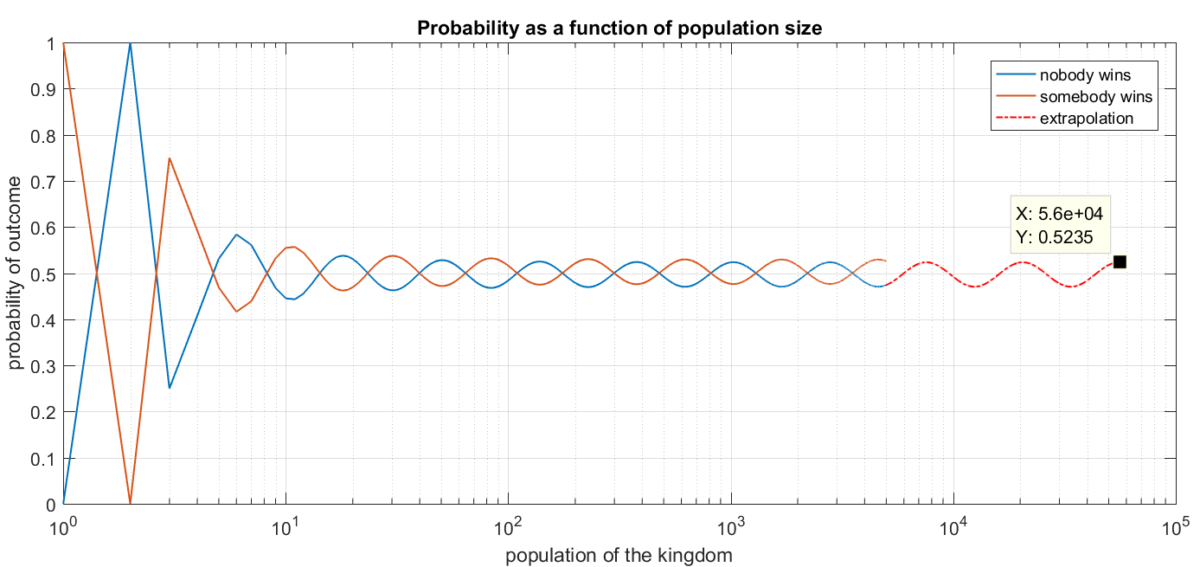
In the first round, every subject simultaneously chooses a random other subject on the green. (It’s possible, of course, that some subjects will be chosen by more than one other subject.) Everybody chosen is eliminated. In each successive round, the subjects who are still in contention simultaneously choose a random remaining subject, and again everybody chosen is eliminated. If there is eventually exactly one subject remaining at the end of a round, he or she wins and heads straight to the castle for fêting. However, it’s also possible that everybody could be eliminated in the last round, in which case nobody wins and the king remains alone. If the kingdom has a population of 56,000 (not including the king), is it more likely that a prince or princess will be crowned or that nobody will win? How does the answer change for a kingdom of arbitrary size?

Here is my solution:
[Show Solution]

Will you be the deciding vote?

Another timely election-related Riddler problem. What are the odds of being the deciding vote?

You are the only sane voter in a state with two candidates running for Senate. There are N other people in the state, and each of them votes completely randomly! Those voters all act independently and have a 50-50 chance of voting for either candidate. What are the odds that your vote changes the outcome of the election toward your preferred candidate?

More importantly, how do these odds scale with the number of people in the state? For example, if twice as many people lived in the state, how much would your chances of swinging the election change?

Here is my solution:
[Show Solution]

The deadly board game

This Riddler classic puzzle involves a combination of decision-making and probability.

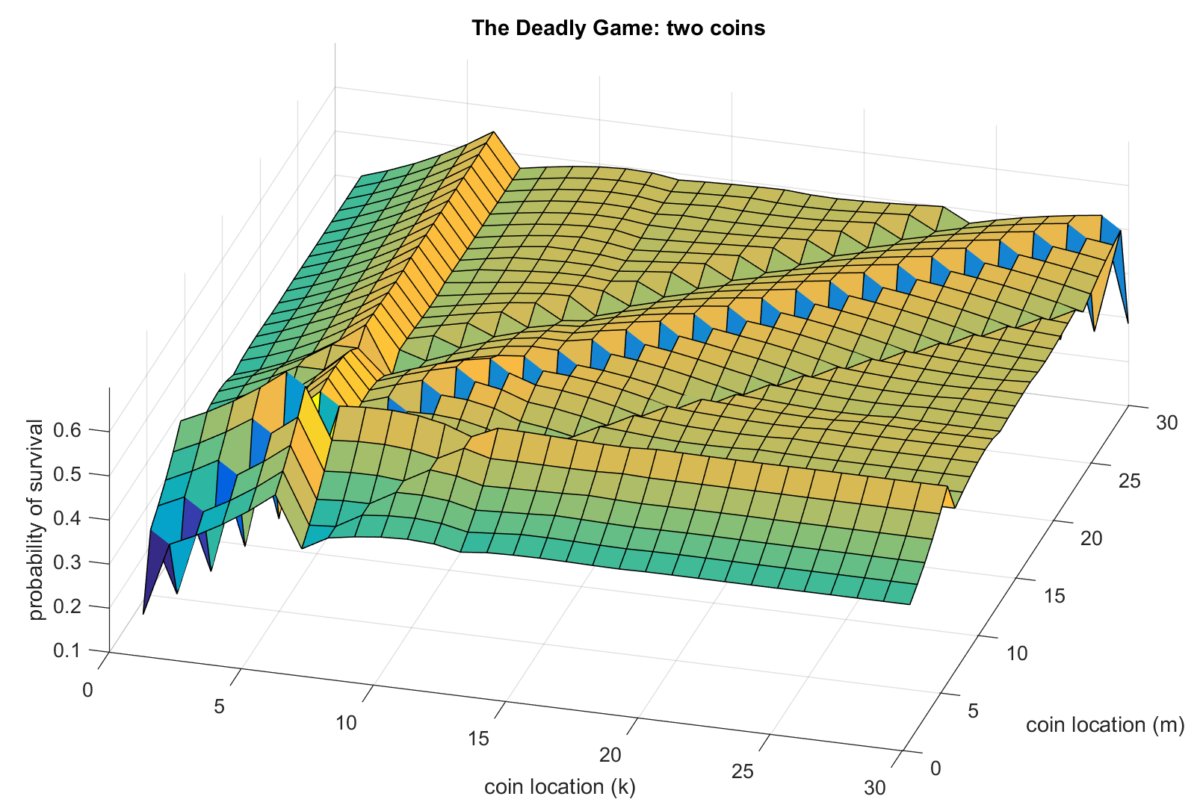
While traveling in the Kingdom of Arbitraria, you are accused of a heinous crime. Arbitraria decides who’s guilty or innocent not through a court system, but a board game. It’s played on a simple board: a track with sequential spaces numbered from 0 to 1,000. The zero space is marked “start,” and your token is placed on it. You are handed a fair six-sided die and three coins. You are allowed to place the coins on three different (nonzero) spaces. Once placed, the coins may not be moved.

After placing the three coins, you roll the die and move your token forward the appropriate number of spaces. If, after moving the token, it lands on a space with a coin on it, you are freed. If not, you roll again and continue moving forward. If your token passes all three coins without landing on one, you are executed. On which three spaces should you place the coins to maximize your chances of survival?

Extra credit: Suppose there’s an additional rule that you cannot place the coins on adjacent spaces. What is the ideal placement now? What about the worst squares — where should you place your coins if you’re making a play for martyrdom?

Here is my solution:
[Show Solution]